Thursday, April 16, 2015

Animated Map of the Western Front of World War One


Click on this link of the map above to direct you to an animated map of the western front of WW1

Technology goes to war

The following graphic shows the way technology changed the strategy and course of the war.

Trench warfare developed over the course of the war due to the conditions (mostly the issue of water and mud) and the battle strategies employed as various technology changed.
The following video is a compilation of images that depict the reality of trench warfare.

Shell Shock was a common response to the constant bombardment and firepower that soldiers faced. The following video records evidence of how shell shock actually affect the human nervous system to spontaneously send random messages all over the body.

This link will give you another re-enacted view of what trench warfare must have been like:
http://www.youtube.com/watch?v=uhhjzR8syXc Class notes here

Christmas Truce


The Christmas Truce of 1914 is a well documented pause in the horrific brutality that was World War One.
http://en.wikipedia.org/wiki/Christmas_truce
The Lyrics of this song by John McDermott describe the event romantically and force us to look at the human tragedy that was this terrible Great War. http://www.youtube.com/watch?v=QTXhZ4uR6rs
Oh my name is Francis Tolliver, I come from Liverpool
Two years ago the war was waiting for me after school
From Belgium and to Flanders, Germany to here
I fought for King and country I love dear.


Twas Christmas in the trenches and the frost so bitter hung
The frozen fields of France where still no Christmas songs were sung
Our families back in England were toasting us that day
There brave and glorious lads so far away.


I was lying with my mess mates on the cold and rocky ground
When across the lines of battle came a most peculiar sound
Says I now listen up me boys, each soldier strained to hear
As one young German voice sang out so clear.


He's singing bloody well you know, my partner says to me
Soon one by one each German voice joined in in harmony
The cannons rested silent and the gas cloud rolled no more
As Christmas brought us respite from the war.


As soon as they were finished and a reverent pause was spent
God Rest Ye Merry Gentlemen struck up some lads from Kent
The next thing sang was Stille Nach tis Silent Night says I
And in two tongues one song filled up that sky


There's someone coming towards us now the front line sentry said
All sights were fixed on one lone figure trudging from their side
His truce flag like a Christmas Star shone on the plane so bright
As he bravely trudged unarmed into the night.


Then one by one on either side, walked in to No Mans Land
With neither gun nor bayonet, we met there hand to hand
We shared some secret brandy and we wished each other well
And in a flare lit football game we gave them hell.


We traded chocolates, cigarettes and photographs from home
These sons and father far away from families of their own
Ton Sanders played the squeeze box and they had a violin
This curious and unlikely band of men.


Soon daylight stole upon us and France was France once more
With sad farewells we each began to settle back to war
But the question haunted every heart that lived that wonderous night
Whose family have I fixed within my sights.


Twas Christmas in the trenches and the frost so bitter hung
The frozen fields of France were warmed, the songs of peace were sung
For the walls they'd kept between us to exact the work of war
had been crumbled and were gone forever more.


Oh my name is Francis Tolliver, from Liverpool I dwell
Each Christmas comes since World War I have learned its lesson well
For the one who calls the shots won't be among the dead and lame
And on each end of the rifle we're the same

Vimy Ridge

Vimy Ridge has come to be known as Canada's coming of age as a nation. This signficant battle was evidence of the resilience and
The following link leads you to a YouTube playlist that tells the in depth storyof Vimy Ridge: http://www.youtube.com/watch?v=SNerOTB-OxQ&feature=results_video&playnext=1&list=PL614044673440C992

RISK WW1 Simulation

Here is how to set up a regular Risk Board to use as modified WW1 simulation:
THE PLAYERS:B= British Empire (red)
F= French Empire (blue)
R= Russian Empire (green)
U= USA (yellow)
G= German Empire (black)
TA= Triple Alliance Members (Italy, Austria-Hungary, & later Turkey) = this team will be the remaining colour left (depends on your board)
Use the following guide to set up your initial configuration of armies according to which force you have decided to represent.
RULES:· Object is to control as much of the world (especially Europe) as possible by the end of the class.
· Everyone starts with 20 soldiers. Every turn you will receive three new players (these players can be placed on any of your territories. We will NOT be using cards or territory counting for extra men.
· On your turn you may either transfer troops (to one of your neighbouring countries, or an ally if they’ll allow it). OR you may attack a neighbouring country (with either of these choices, at least ONE man MUST be left behind). OR you make choice to not move or attack.
· If you are the USA, you are not allowed to move any forces for 2 turns. On that turn you may move a maximum of 15 men (from a single country) to Scandinavia.
· Countries unoccupied will remain unoccupied.
· No Genocide!! You can not completely annihilate any single player. (once down to one country… hands off!)
· We have created new lines. One is between Quebec and England, and the other is between Western Canada and China
What alliances developed if any? Did players honor these alliances?
Did you think about the individual lives that were at stake in each move or were you mostly interested in the strategies needed to win your objectives?
If you were to play again would your strategy be different?
In the end was a balance of power between contending forces achieved or when certain players got an advantage did the other players gang up on them?
Compare how your game went with the dynamics of World War 1.

R.I. #2 Part One Study Guide


Terms you should undertand
Sovereignty
National interests
National Self-interest
Gross domestic product (GDP)
Minority groups
Armistice
League of Nations
Balance of Power

You should know...
...the various logical fallacies and how they are used in debates.
...the difference between the following concepts
   --Peacekeeping and Peacemaking
   --Domestic policy and Foreign Policy
...what the role of the Ottoman Empire was both before and after World War One
...why Palestine is important in the balance of power in the Middle East.
...what a typical progression of control in middle eastern countries looks like
...how technology affected the way WW1 was fought.
...what happened at the important battles of the WW1 (who won, why was it important, etc)
...the main causes of WW1 and how each one caused the The Great War.
You should be able to describe what the Treaty of Versailles accomplished and how it is affect the nations on both sides of World War 1.
For a list of all the Related Issue 2 topics on this website click here

world war one causes and effects review

Arctic Sovereignty

An overview of the contending countries due to main issues surrounding Arctic Sovereignty.


Russia's First Move
Check out this news story identifying the bold move Russia took to claim parts of the Arctic Ocean - and the initial response from the affected countries. http://www.youtube.com/watch?v=YujsRuN3PK8&feature=related
Canada's Response?
Rick Mercer identifies the irony of Canada's position on increased surveillance of its Arctic region by purchasing fighter planes that have been prescribed by USA.
http://www.youtube.com/watch?v=3sG2f2NfOso
For review:
Key terms
Sovereignty, National Interest and Foreign Policy
Question: What do you think the appropriate response Canada should take on this issue?
Of the following factors which one do you think should be the most important in making decisions about the arctic region? (Rank these in order of importance)
Use your textbook pages 119-121 for more information on this issue

Oil and Gas Reserves
Environmental Concerns
Well-being of the Wildlife
Aboriginal Land Claims
Transportation routes
National security

Tuesday, March 3, 2015

The French Revolution: Review in 3 episodes

the following is the PDF version of the notes for the French Revolution - you can use these slides to complete your notes

1.11 Chapter Two French Revolution by MrFriesen007

If you are like most people, the French Revolution has a way of getting confusing really fast. It's hard to keep you raiding peasants separate from your fleeing monarchs. Sometimes you need to get it all in a relatively concise format. So inorder to give you a chance to review this stuff - as painlessly as possible here is the whole thing in three 6ish minute episodes.

or you can find them on Youtube here; here; and here. Enjoy!

Tuesday, December 4, 2012

The Storming of Juno

Click to link to the interactive website on the storming of Juno Beach.

Friday, November 16, 2012

Turning Hitler into a god or a devil?

LENI RIEFENSTAHL was a popular German movie star whose prominence also allowed her to have influence with Adolf Hitler. Hitler saw her as the ideal German woman and asked her to direct a movie about him.
 

Walt Disney also got involved in using movies for the purposes of propaganda.

Conspiracy

What is a conspiracy?
How do conspiracies work? Typically agents of power (government/business) hide certain reasons or actions that would make their activities unacceptable to the general public if they were revealed for what they really were. One example of this is the the way that corporations exercise control over government legislation.
Here is one example that might affect the way we think about food.

What are chicken nuggets made out of? Watch this video here
Are chicken nuggets a conspiracy? Not really. Most of us know instinctively that much like hot dogs are made of leftover bit of animal so too chicken nuggets are made of nasty bits of chicken. Of course we conveniently forget this fact when we are standing at the counter of McDs.
But what about the idea of how we make choices about what food is healthy or not healthy.


It seems that the food that is the healthiest for us is not only the most expensive but also the food that will spoil the quickest (and its all found on the perimeter of the your local grocery store). Is your grocery store conspiring to make you choose unhealthy food over more nutritious food? Good question. Is it any wonder that cases of obesity are much higher in poorer families than in richer families?
But it gets worse. Many food companies get really upset when we change the rules about how we think about food. Take the latest ideas suggested by Michelle Obama (2010) to reduce salt, and increase vegetables in school cafeteria lunches. Frozen pizza makers like McCain's got real nervous when schools started talking about removing their products and replacing them with healthier choices. So...
watch this
Here is how the system works...
A company like McCain's lobbies government representatives so that they change the classification of pizza to a vegetable. That way cafeterias can still meet their daily requirement of vegetables and they can do with pizza which students will pound down like...   ...well...   ...pizza.
So is this a conspiracy? Well, since the connection between corporations and government is largely done behind closed doors - you certainly could build a strong case that this is a conspiracy.
Changing the way we think about food and implementing laws about that is something we should ask questions about. Is it true that these companies are trying to make us unhealthy? No. They are trying to make a profit.
So what happens when profit becomes the motivating factor in making government decisions. Could it be that the idea to go to war might be motivated by profit even more than by the reasons we are usually given?
That is the whole point of the documentary called "Why We Fight"
Here is the connection that this film is making...

Military equipment is an industry. Large corporations run these industries. They make weapons for countries and sell them for a profit. Once a country figures it has enough bombs and guns and fighter jets it stops buying that stuff from this industry. Now the industry has a problem. It can't sell anymore of its products. So it needs to create a demand for its products. How does it do this? By suggesting to the government that it should use up some of these weapons in some sort of military action. In fact it uses the same methods of lobbying that the food companies use to convince politicians that the idea to go to war is a good one.
After watching the documentary, respond to the following questions:
What is the military industrial complex and how does it work?
What were the reasons to go into Iraq given by the government?
What other hidden reasons might have motivated the government to go to war in Iraq?
Why do Americans fight?
What is the connection between profit and foreign policy?
Is there a conspiracy in this situation?

Crisis and Ultranationalism: Three WW2 Case Studies

In this course we look at four major factors athat contribute to the rise of ultranationalism:
1. Crisis
2. Expansionist National Interests
     -the belief that expanding the territory of the country could benefit the country to make it eceonomically, ethnically, socially, or politcally more secure.
3. Charismatic Leadership
4. Instilling Ultranationalist Values and Beliefs (using propaganda)
This post will focus on the issue of Crisis and how it leads to ultranationalism
We will focus on three aspect of crisis that contribute to ultranationalistic sentiments
Based on what was discussed in class - can you identify the general crisis that the world was facing in each of these areas?
How did the Great Depression contribute to global crisis? Both national and international crisis contributed to the rise of ultranationalist sentiments in each of the following countries.
Japan
Italy
Germany
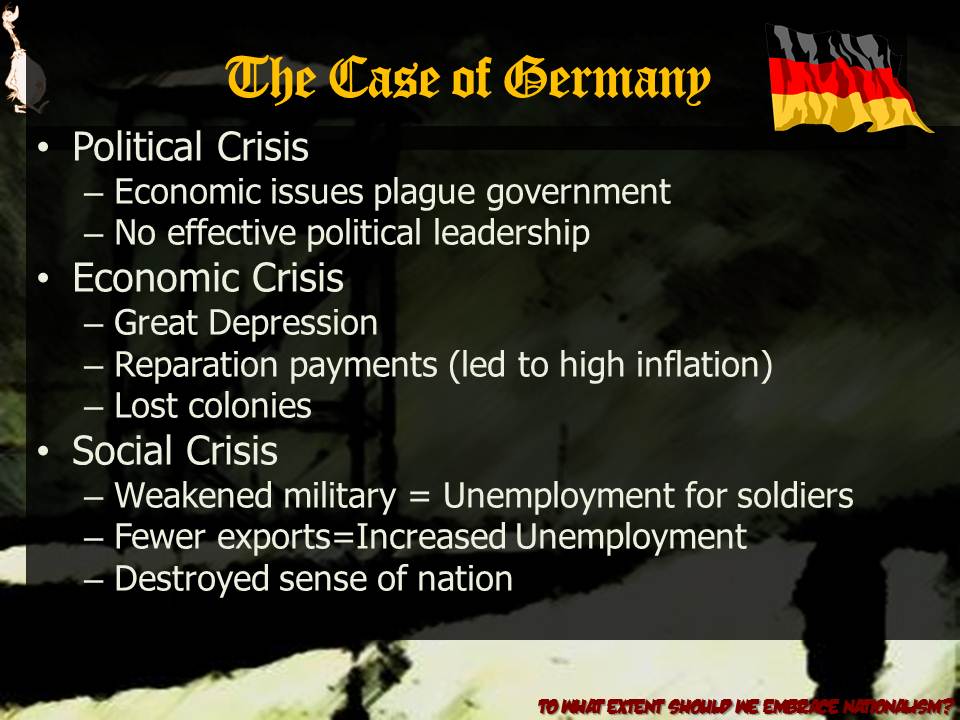
Germany's situation was arguably the worst of the three since on top of similar issues the other countries were facing Germany was also trying to pay off the War Debt it was saddled with after WW1 through the Treaty of Versailles.
In each of these three cases the first action that they each made was to expand their territory. This they believed was in their national interests.
and
What was the worlds response?
Appeasement
so Germany is essentially allowed to invade various surrounding areas until it starts looking ever so greedily at Poland

Friday, October 19, 2012

P-p-p-p-passion

How do we know how much passion and emotion is appropriate? Is there ever a time when emotional expression can go too far? What about the other way: is there a danger in not being passionate enough?
Listen to the following debate on the role of anger in our society then answer the BIG question listed below the video in this post...
 
Answer this question in a short paragraph:
Which is worse too much passion or too little passion?

Logical Fallacies

Here are three videos that identitfy some of the important logical fallacies commonly used erroneously used in debate strategies...

Monday, September 24, 2012

Contending Loyalties

After reading the Quebec Separatist notes and pages 77-79 in your text complete the following survey...
Create your free online surveys with SurveyMonkey, the world's leading questionnaire tool.
if the survey does not appear in this post click the link below to start a stand alone version... Click here to open a stand alone version of the survey

National Anthem Idol

How does music evoke a sense of nationalism.
Here is a link to a few national anthems - rank them according to the criteria you come up with in class.
Russian: http://www.youtube.com/watch?v=A71wdsTqkfM&feature=related
Brazil: http://www.youtube.com/watch?v=AuML6DJlBNs
Israel: http://www.youtube.com/watch?v=NjfFpFW9OdA
Nicaragua: http://www.youtube.com/watch?v=M0aDAX-btLg
Japan: http://www.youtube.com/watch?v=Rkgo5uvMFR8
France: http://www.youtube.com/watch?v=GubbhQuHISY
Australia: http://www.youtube.com/watch?v=stL6EBxeJGM

Hegemony: How are we being controlled?

This video suggests our actions are being monitored in ways that we may not be aware of. But are there other more subtle ways that the culture and civic institutions dictate our behaviour? In what ways are our actions being regulated so that we conform to what is considered 'acceptable' behaviour? Hegemony is a term that is used to identify ways that society is comes together to behave in a singular way. The fact that English and French are the dominant languagesof our nation means that court proceedings are not conducted in Mandarin or Polish. If someone of Polish or Chinese background cannot master the English language, is it possible that they might not fare as well in their case? Hegemony is way more sneaky and subtle. Think of the fact that we all stop at a stop light even when no one else is at the intersection at midnight. That's hegemony.
Hegemony are the ways cultural behaviour is controlled often without us even realizing that we are being controlled.

Tuesday, September 11, 2012

Collective consciousness

Collective consciousness was a term coined by the French sociologist Émile Durkheim (1858–1917) to refer to the shared beliefs and moral attitudes which operate as a unifying force within society.
An awareness or ideas SHARED by many people. It may be based on a SHARED memory of and pride in specific events, which become myths and symbols of belonging.
Durkheim was interested in explaining the factors that contributed to a groups collective identity. He looked for shared experiences, practices, and ideas that helped solidify a group so that they could act as a single body or unit. Collective consciousness is a stronger concept than just know about the same things - it addresses the way shared experiences motivate people to behave  in the same or similar ways to all the rest of the people in the same group that they belong to...